Mercedes OM607 1.5 CDI Engine: Specs, Reliability & Failure Analysis
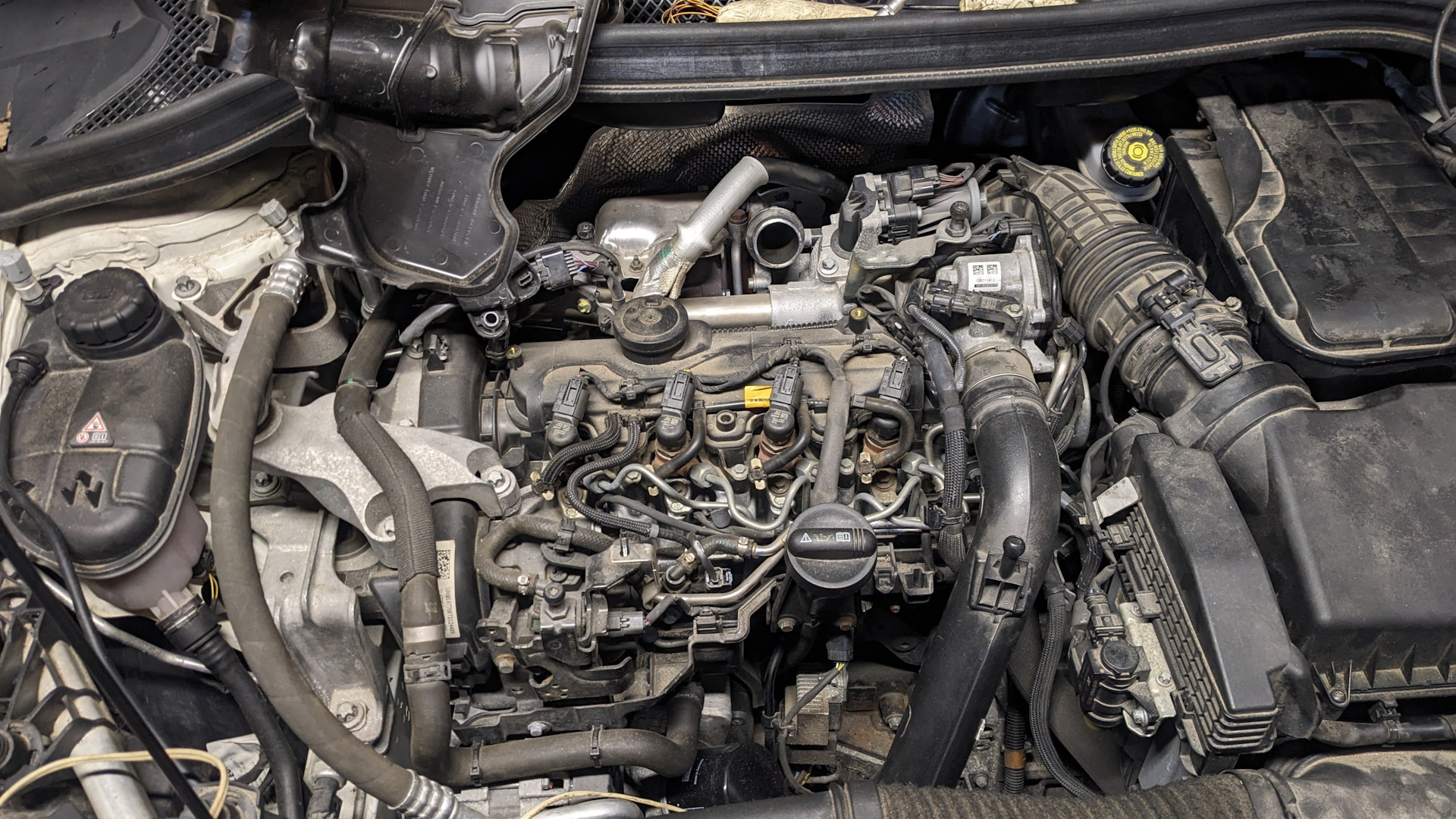
The Mercedes-Benz OM607 is a 1.5-liter, four-cylinder turbocharged diesel developed from the Renault K9K engine architecture for Mercedes applications. In the original 2012 A 180 CDI (W176), the OM607.951 combines common-rail injection, a timing-belt-driven camshaft, a variable-geometry turbocharger and a diesel particulate filter. The same Mercedes engine designation also appears in documented A-Class, B-Class, CLA, GLA and Citan applications, with different output calibrations.
Identification matters more than the badge on the tailgate. An early A 180 CDI could have either the 1.5-liter OM607 or a separate 1.8-liter OM651, depending on vehicle configuration. The OM607 also has different hardware and maintenance requirements from the later OM608. For service, diagnosis or replacement parts, the exact engine code and vehicle configuration should take precedence over a model name or a generic description of the Renault K9K family.
Mercedes-Benz OM607.951
Specifications and Engine Identification
Mercedes-Benz’s June 2012 technical introduction establishes the principal dimensions and the initial A 180 CDI output. Figures for that vehicle must not be treated as specifications for every OM607-equipped Citan or lower-output passenger-car version.
| Specification | OM607.951 in the original A 180 CDI W176 |
|---|---|
| Engine configuration | Inline-four diesel; two valves per cylinder |
| Displacement | 1,461 cc |
| Bore × stroke | 76.0 × 80.5 mm |
| Cylinder spacing | 85.0 mm |
| Compression ratio | 15.4:1 in the OM607.951-specific section; 15.5:1 in the general 2012 diesel-engine table (unresolved OEM discrepancy) |
| Rated power | 80 kW at 4,000 rpm |
| Rated torque | 260 Nm at 1,750–2,500 rpm |
| Maximum boost pressure | 0.7 bar, as listed for this 2012 calibration |
| Timing drive | Toothed belt |
| Injection system | Common-rail direct injection; Continental IIC-coded injectors; 1,600-bar generation specification |
| Engine management | Continental SID307 in the documented W176 arrangement |
| Turbocharging | Vacuum-controlled variable turbine geometry |
| Charge-air cooling | Air-to-air intercooler |
The 1,600-bar injection figure is a generation-level maximum identified by Mercedes when contrasting OM607 with the later OM608, not a constant live rail-pressure target.
The 2012 A 180 CDI with chassis variant 176.012 and a six-speed manual transmission is specifically identified with OM607.951. An A 180 CDI with the 1.8-liter OM651 is a different engine application despite the shared model badge. Transmission type alone should not be used to classify all subsequent A 180 CDI or A 180 d vehicles; later combinations require their own engine identification.
Which Mercedes Models Used the OM607?
Hengst’s application catalogues identify OM607.951 across several Mercedes model lines. The intervals shown are catalogue part-fitment periods, not proof of complete engine manufacturing dates or availability in every country. Power is stated for each listed configuration rather than being merged into an artificial engine-wide range.
| Vehicle | Chassis / variant | Catalogue fitment interval | Rated power |
|---|---|---|---|
| A 160 CDI / A 160 d | W176, 176.011 | 06/2013–05/2018 | 66 kW |
| A 180 CDI / A 180 d | W176, 176.012 | 06/2012–05/2018 | 80 kW |
| B 160 CDI / B 160 d | W246, 246.211 | 05/2013–12/2018 | 66 kW |
| B 180 CDI / B 180 d | W246, 246.212 | 02/2013–12/2018 | 80 kW |
| CLA 180 CDI / CLA 180 d Coupé | C117, 117.312 | 10/2013–05/2018 | 80 kW |
| CLA 180 d Shooting Brake | X117, 117.912 | 07/2015–05/2018 | 80 kW |
| GLA 180 CDI / GLA 180 d | X156, 156.912 | 07/2014–05/2018 | 80 kW |
| Citan 108 CDI | W415 Tourer 415.703; panel van 415.601 / 415.603 | 11/2012–08/2021 | 55 kW |
| Citan 109 CDI | W415 Tourer 415.703; panel van 415.601 / 415.603 / 415.605; selected Mixto variants | 11/2012–08/2021 | 66 kW |
| Citan 111 CDI | W415 Tourer 415.703 / 415.705; selected Mixto variants | 06/2013–08/2021 | 81 kW |
For the Citan, Hengst specifically records OM607.951 for the listed power versions and body configurations, but this does not establish identical ECU, emissions hardware or transmission arrangements for every vehicle. A Renault K9K sub-designation in a separate record is not an interchangeable Mercedes engine-number suffix. Mercedes’ statement that certain European passenger-car OM607 configurations ceased production by 2017 concerns the scope of its later KBA emissions action; it does not invalidate Citan catalogue fitment entries extending into 2021.
Likewise, the OM608 introduced with the newer compact-car generation is a separate engine, not an OM607.951 hardware revision. Mercedes lists different injection pressure, electric turbocharger control and water-to-air charge cooling for the OM608.
Mechanical Design: Timing Belt, Lubrication and Boost Control
Timing belt and accessory drive
The OM607 uses a toothed timing belt rather than the timing chain found on some other Mercedes diesels. In the documented W176 installation, the belt drives the camshaft, coolant pump and high-pressure fuel pump. Mercedes also shows a separate six-rib poly-V belt for the alternator and air-conditioning compressor.
This arrangement is important when checking maintenance history: evidence of accessory-belt replacement is not evidence that the camshaft timing belt was replaced. The timing-belt work must follow the exact vehicle’s WIS procedure, including the correct timing and tensioning operations. The cited technical material does not identify a characteristic premature belt-failure mileage.
Bottom end, bearings and oil circuit
The Mercedes training material shows a demand-controlled engine oil pump, an oil-to-coolant heat exchanger, crankshaft and connecting-rod lubrication, and piston oil-spray nozzles. It also explicitly identifies an aluminum-alloy oil sump. These are verified features of the documented engine arrangement; exact cylinder-block and head materials, bearing clearances and detailed piston or liner construction are not established to the same standard here.
A separate Mercedes workshop note, AH03.10-P-0001-03MM, addresses how to assess certain connecting-rod bearing and crank-journal surfaces on engines including OM607. It describes a particular exposed copper-colored bearing-overlay appearance as acceptable rather than automatically requiring replacement. Actual scoring, seizure or other damage must still be evaluated separately.
This inspection note is not evidence of premature OM607 bearing failure. No recurrent OM607-specific cause of excessive engine-oil consumption, such as ring sticking, turbocharger seal leakage or crankcase-ventilation failure, has been established by the cited technical evidence. Problems attributed to older or differently configured Renault K9K versions must not be transferred to OM607.951 without a direct applicability source.
Variable-geometry turbocharger and charge-air path
The original OM607.951 W176 installation uses a single variable-turbine-geometry turbocharger. A pulse-width-modulated control arrangement operates the guide vanes through a vacuum-controlled positioner. Compressed intake air passes through an air-to-air intercooler before entering the engine.
The boost-control positioner has a specific diagnostic complication: the Mercedes technical introduction identifies a 0.24 mm bypass bore. Because of this designed air passage, failure to hold vacuum in a conventional static leak test is not by itself evidence of a defective positioner. Mercedes also identifies possible function impairment from contamination of the associated filter. The applicable Xentry/WIS control-system procedure, rather than an ordinary vacuum-hold test alone, should guide interpretation.
Consequently, unusual boost noise, hesitation and reduced power should not all be assigned to the turbocharger core. The air duct, vacuum-control arrangement and the actual condition recorded by vehicle diagnostics must be distinguished before choosing a repair.
Continental injection, SID307 and injector coding
The 2012 OM607.951 has a high-pressure fuel pump, rail, rail-pressure sensor, metering valve and electronically controlled injectors. Mercedes identifies Continental SID307 within the original W176 CDI and drivetrain-control architecture.
Each injector carries an individual IIC correction code. When an injector is replaced, Mercedes specifies entering that code into the CDI control unit with Xentry Diagnostics. Mechanical installation of the replacement part alone is therefore not the complete documented replacement process.
There is no basis in the OM607-specific evidence to describe earlier Renault Delphi fuel-injector or injection-pump problems as characteristic OM607 defects. Component identity and control strategy must be verified for the actual vehicle.
Cooling and emissions hardware
The original cooling diagram includes the belt-driven coolant pump, thermostat, radiator, expansion tank, EGR cooler and oil-to-coolant heat exchanger. The precise coolant quantity and thermostat calibration are not established as universal figures for all OM607 installations.
For the original W176 version, Mercedes describes both high-pressure and low-pressure exhaust-gas recirculation paths, with their actuators, an exhaust flap and control feedback. The exhaust system includes an oxidation catalyst, diesel particulate filter (DPF), differential-pressure monitoring, exhaust-temperature sensing and a lambda sensor. The documented DPF regeneration strategy uses post-injection and a heater-booster arrangement. These are connected but distinct control functions; an EGR-related warning does not identify a particular valve or exhaust component without further diagnosis. Later commercial-vehicle emissions specifications should not be assumed identical without checking the vehicle configuration.
Reported OM607 Problems and Repair Findings
The most specific professional repair overview located for the OM607 is L’Argus’s reliability reporting on the W176 A-Class. It separates problems attributed to the 1.5-liter OM607 from timing-chain complaints involving the 1.8-liter OM651. Three OM607-associated observations are useful for fault investigation:
| Reported condition | Symptoms | Source-supported repair association | What remains unresolved |
|---|---|---|---|
| Dual-mass flywheel | Abnormal noise at idle | L’Argus associates the complaint with flywheel replacement | Internal wear mechanism, incidence and mileage threshold |
| Coolant loss / cylinder-head investigation | Unexplained reduction in coolant level | L’Argus names the cylinder head in connection with the concern | Exact leak path; whether a gasket, casting or another component is responsible |
| Charge-air duct | Unusual noise during boost | L’Argus identifies an air-duct concern, referring to vehicles up to October 2015 | Verified redesign date, original/revised part numbers and defect prevalence |
Idle noise and the dual-mass flywheel
An idle noise in an OM607-powered W176 does not, by itself, establish a fault inside the engine. L’Argus associates an OM607-specific idle-noise complaint with replacement of the dual-mass flywheel, a drivetrain component rather than a crankshaft or valvetrain part. The flywheel therefore belongs in the investigation before internal-engine disassembly is proposed. The report does not establish an exact noise signature, physical flywheel failure mechanism or replacement mileage.
Unexplained coolant consumption
L’Argus also flags abnormal coolant consumption and refers to cylinder-head intervention. The source does not identify a definite physical path for the coolant loss. It would therefore be inaccurate to present cracked cylinder heads, porous castings or failed head gaskets as confirmed recurring OM607 mechanisms on this evidence alone.
A vehicle showing coolant loss needs a diagnosis of the actual leakage or consumption route before the source’s repair association is used to justify cylinder-head work. Replacement of a thermostat or another cooling-system part in an isolated owner’s repair record does not demonstrate a population-wide cooling defect.
Boost noise and the charge-air duct
The third L’Argus observation concerns abnormal turbo/boost noise associated with an air duct, in an identified group of W176 vehicles up to October 2015. This makes the charge-air path a relevant area of investigation when the symptoms match. It does not confirm turbocharger bearing damage, a failed variable-geometry mechanism or a factory-revised hose introduced at that date.
Engine Warnings, DTCs and Misdiagnosis Risks
Mercedes bulletin LI54.18-P-057974: P022664
Daimler technical bulletin LI54.18-P-057974, dated 6 December 2013 on the document itself, addresses intermittent engine-management and ESP/BAS/PRE-SAFE warnings in specified models 117, 176 and 246 using several engine families. Its P022664 entry is expressly applicable to OM607.
The bulletin associates the code with electronic accelerator function monitoring and an implausible signal. It lists intermittent contact resistance as a possible explanation. After the applicable Xentry tests, the OEM procedure calls for attention to CDI and accelerator-pedal connectors, grounding points and terminal/pin contact tension. Mercedes cautions against indiscriminate component replacement and contact-spray use. The document is a multi-engine bulletin, with P022664 assigned to OM607; a different fault code listed for OM651 must not be carried over. This is a diagnostic possibility, not a verified recurring OM607 defect.
| Code | Evidence | Interpretation for an OM607 article |
|---|---|---|
| P022664 | Mercedes technical bulletin | Electronic accelerator signal plausibility; follow applicable Xentry electrical checks |
| P049A | Unverified owner reports | Recorded in EGR-related complaints; exact OEM strategy meaning and cause not established here |
| P049B | Unverified owner report | Recorded during an unresolved emissions-related warning; does not identify a failed component |
Model-forum discussions additionally mention exhaust-pressure codes such as P0470/P0471, but the relevant engines and OEM code definitions are not sufficiently established in this evidence base to treat them as OM607-specific factory diagnostic entries. The GLA owner’s boost account likewise does not confirm P0299 as an actually retrieved code from that vehicle.
Why EGR and turbo complaints require separate diagnoses
An EGR-related warning does not establish whether the fault lies in a valve, sensor, exhaust restriction, control calibration or another subsystem. Similarly, reduced boost can coexist with a charge-air duct issue without demonstrating damage inside the turbocharger. The original OM607 includes more than one EGR path, controlled turbo vanes and several exhaust-monitoring inputs. A component should not be condemned solely on the basis of a broadly related fault code or a previously unsuccessful repair.
Emissions Software Actions and Citan Recall Coverage
German KBA action affecting selected OM607 passenger cars
Mercedes-Benz confirms that German KBA administrative orders issued in the fourth quarter of 2022 concerned temperature-dependent EGR-control functions in certain Euro 5 and Euro 6b OM607-equipped A-Class, B-Class, CLA and GLA vehicles. The manufacturer described software updates and customer notification for the affected configurations.
This is an official regulatory emissions action concerning engine-management calibration. It is not proof that the mechanical EGR valve is defective or that every OM607 has been recalled. Vehicle eligibility and completion of an update are VIN-specific; historic figures for vehicles still awaiting the update should not be read as current totals.
EU Safety Gate A12/1020/19: selected Citan versions
The European alert A12/1020/19, dated 12 July 2019, concerns specified Citan 108/109 CDI and 111 CDI configurations. In the notice, example passenger-vehicle (M1) windows are June 2015–December 2016 for the 108/109 CDI and June 2015–February 2017 for the 111 CDI. Commercial-vehicle (N1) windows differ and must be taken from the notice. The cited hazard is faster-than-expected deterioration of an unidentified emissions-control component, potentially increasing nitrogen-oxide emissions.
The official notice does not identify OM607.951 by engine suffix, disclose the exact defective component or publish an original-to-revised part-number pair. It belongs in a vehicle-specific emissions recall history, not in a list of established OM607 internal-engine failures. Owners should use the VIN and the manufacturer’s current campaign records to establish applicability.
No separate OM607-specific NHTSA safety recall or mechanical-defect warranty extension was established in the available sources. That restricted finding should not be interpreted as evidence that no other national or VIN-specific action exists.
Timing-Belt Intervals, Oil Capacity and Maintenance
Mercedes published different timing-belt intervals for different regions in the original W176 service introduction. The figures below are a historical factory baseline for that documented application, not a universal modern schedule for every Citan or later A/B/CLA/GLA installation.
| Service operation | Documented value | Applicability / limitation |
|---|---|---|
| Timing-belt replacement — Europe | 200,000 km or 10 years | 2012 W176 OM607 launch service plan |
| Timing-belt replacement — other regions | 100,000 km or 5 years | Other countries under the same original service plan |
| Coolant replacement | 200,000 km or 10 years | 2012 W176 OM607/OM651 service documentation |
| Engine-oil change capacity including filter | 4.5 L | 2012 A 180 CDI BlueEFFICIENCY, manual transmission |
| Approved engine-oil specification sheets | MB 228.51, 229.31, 229.51 | As listed in the 2012 DPF-equipped diesel owner’s manual |
| Universal oil-change interval | Vehicle-specific | Use the correct ASSYST PLUS / WIS schedule |
Mercedes explicitly treats its 2012 printed technical introduction as non-updating reference material. Where the vehicle’s current WIS, maintenance record or country-specific service schedule differs, the correct VIN-specific procedure takes priority. The same caution applies to oil viscosity, coolant specification and fluid quantities. A capacity confirmed for the 2012 manual-transmission A 180 CDI should not be copied to every OM607-equipped chassis.
Timing-belt service history deserves particular attention because the camshaft belt also drives the water pump and high-pressure fuel pump. The available source does not establish that water-pump replacement is a universal mandatory addition to every belt service, nor does it supply the complete locking-tool, fastener-torque and timing procedure. Those details must come from the applicable Mercedes workshop instructions.
What OM607 Owners Have Reported
The following accounts provide practical symptom and repair-history context, but remain unverified field reports. Reports reposted by the same author are treated as one case, not independent corroboration.
B 180 d W246: recurring emissions warning
An Italian owner of a 2017 B 180 d with the 1.5-liter K9K/OM607 described repeated check-engine warnings involving P049A and P049B, mostly in urban use. The car had been purchased at approximately 96,000 km; the owner described further trouble over roughly 3,000 km. A proposed catalyst-related repair was disputed, and the final underlying cause was not independently confirmed. This case illustrates the risk of equating an emissions-related diagnostic code with a proved catalyst or EGR hardware failure.
A 180 d W176: hesitation after EGR and charge-air repairs
A second owner, reporting a 2016 Italian A 180 d OM607 with 7G-DCT and approximately 158,000 km, described hesitation on long, hot motorway drives despite earlier EGR and charge-air work. A historical P049A was mentioned, but no active fault code was described at the time of the particular complaint. The report does not identify which previous repair, if any, caused the subsequent symptoms.
GLA 180 CDI: unresolved boost and power-loss history
A 2015 GLA 180 CDI owner in Greece described repeated boost-related loss of power and several workshop events over multiple years. The technical interpretations are the owner’s, not independently verified teardown findings or a definitive diagnosis. The same account appeared in more than one community and should be counted as one owner’s experience.
These different diagnostic histories show the importance of reviewing stored fault codes, previous repairs and whether symptoms persisted after the work, rather than assuming the same component failed in each vehicle.
What to Check Before Buying an OM607-Powered Car
The highest-value checks follow from the engine identification, maintenance and reported-condition evidence rather than from a generic list of diesel concerns.
- Verify the engine code. Confirm the actual OM607.951 application rather than relying on an A 180 CDI badge, displacement assumption or gearbox type.
- Check timing-belt records. Confirm the applicable market-specific service schedule and evidence of the relevant belt work, not merely accessory-belt replacement.
- Investigate idle noise. The professional repair record specifically associates one OM607 W176 idle-noise complaint with the dual-mass flywheel.
- Ask about unexplained coolant loss. Review the repair diagnosis, not just whether coolant or a component was replaced. The published OM607 head-related report does not identify one universal leak mechanism.
- Assess boost noise or reduced power. Pay attention to documented charge-air duct work and any unresolved turbo/boost complaint, particularly in the W176 period identified by L’Argus.
- Review engine and emissions DTC history. Look for evidence of a completed diagnosis and confirm whether symptoms returned after EGR, charge-air, sensor or catalyst work.
- Verify injector coding after replacement. The 2012 Continental system requires entry of injector-specific IIC data in Xentry.
- Check official VIN-specific emissions actions. This includes the OM607 KBA software action on relevant passenger cars and the restricted Citan recall when applicable.
A car with a past engine warning is not necessarily suffering a proven engine failure; equally, repeated unresolved warnings should not be dismissed because an emissions component has already been replaced. Documentation of the actual diagnosis, work performed and outcome is more informative than a parts invoice alone.
OM607 Reliability: What the Evidence Supports
The available evidence does not support a numerical OM607 failure rate, expected engine lifespan or ranking against other Mercedes diesels. It does support more specific service decisions: distinguish a flywheel-related idle noise from internal-engine damage, establish the actual source of coolant loss before cylinder-head work, and separate charge-air duct symptoms from a presumed failed turbocharger.
For diagnosis and ownership, the decisive records are the exact engine/VIN identification, region-appropriate timing-belt history, correct Continental injector coding, Xentry findings and completion of VIN-specific emissions actions. Unresolved EGR or boost complaints warrant targeted investigation rather than a parts-based assumption.
Sources & Technical References
- Mercedes-Benz Service — Introduction of the New A-Class, Model Series 176, order no. 6516 1393 02 (June 2012); original OM607.951 specifications, architecture and service introduction. OEM documentation mirror.
- Mercedes-Benz — A-Class Hatchback W176 Owner’s Manual (2012); documented oil approvals and application-specific service-fill data.
- Hengst Filtration — A-Class, B-Class, CLA and GLA application catalogue; OM607.951 chassis identification, outputs and fitment intervals.
- Hengst Filtration — Citan W415 application catalogue; named OM607.951 Citan variants and power calibrations.
- L’Argus — Fiabilité Mercedes-Benz Classe A III W176; OM607-specific flywheel, cooling and charge-air observations, distinguished from OM651 complaints.
- Daimler — LI54.18-P-057974, dated 6 December 2013 on the OEM document; accelerator-signal diagnostic guidance, reproduced with NHTSA communication index 10096448.
- Mercedes-Benz Group — Diesel software updates and service measures in Europe; KBA OM607 EGR-control action for specified passenger-car configurations.
- Rappel Conso / EU Safety Gate — A12/1020/19; selected Citan emissions-related recall and restricted production periods.
- Daimler — AH03.10-P-0001-03MM; connecting-rod bearing inspection criteria, including the OM607/622/626 coating example (French-language reproduction, document pp. 1–4; PDF pp. 3–6). OEM workshop documentation mirror.
- Mercedes-Benz Media — The New A-Class: Technology (2018); engineering distinction between OM607 and its OM608 successor.
Field Sources
- Autopareri — 2017 B 180 d W246 owner account; P049A/P049B warnings and unresolved emissions-related repair assessment.
- Reddit, r/mercedes_benz — 2016 A 180 d W176 owner account; hesitation following EGR and charge-air repairs.
- Reddit, r/mercedes — 2015 GLA 180 CDI owner account; individual repeated power-loss and workshop history.