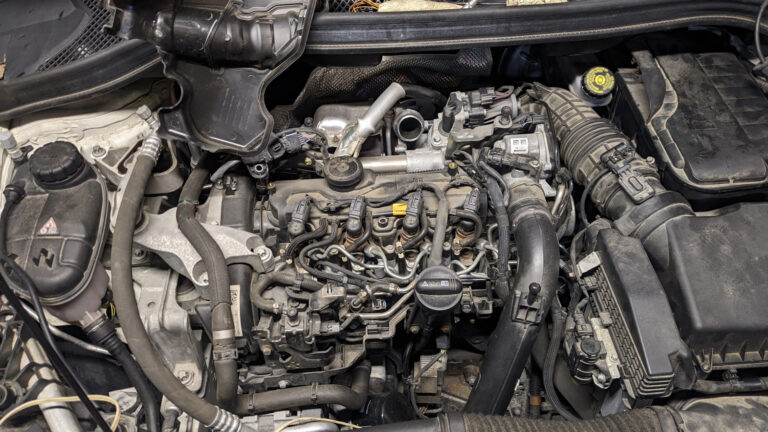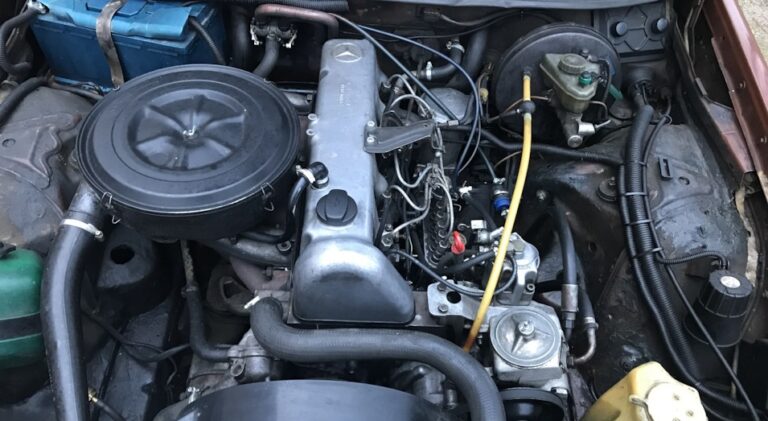
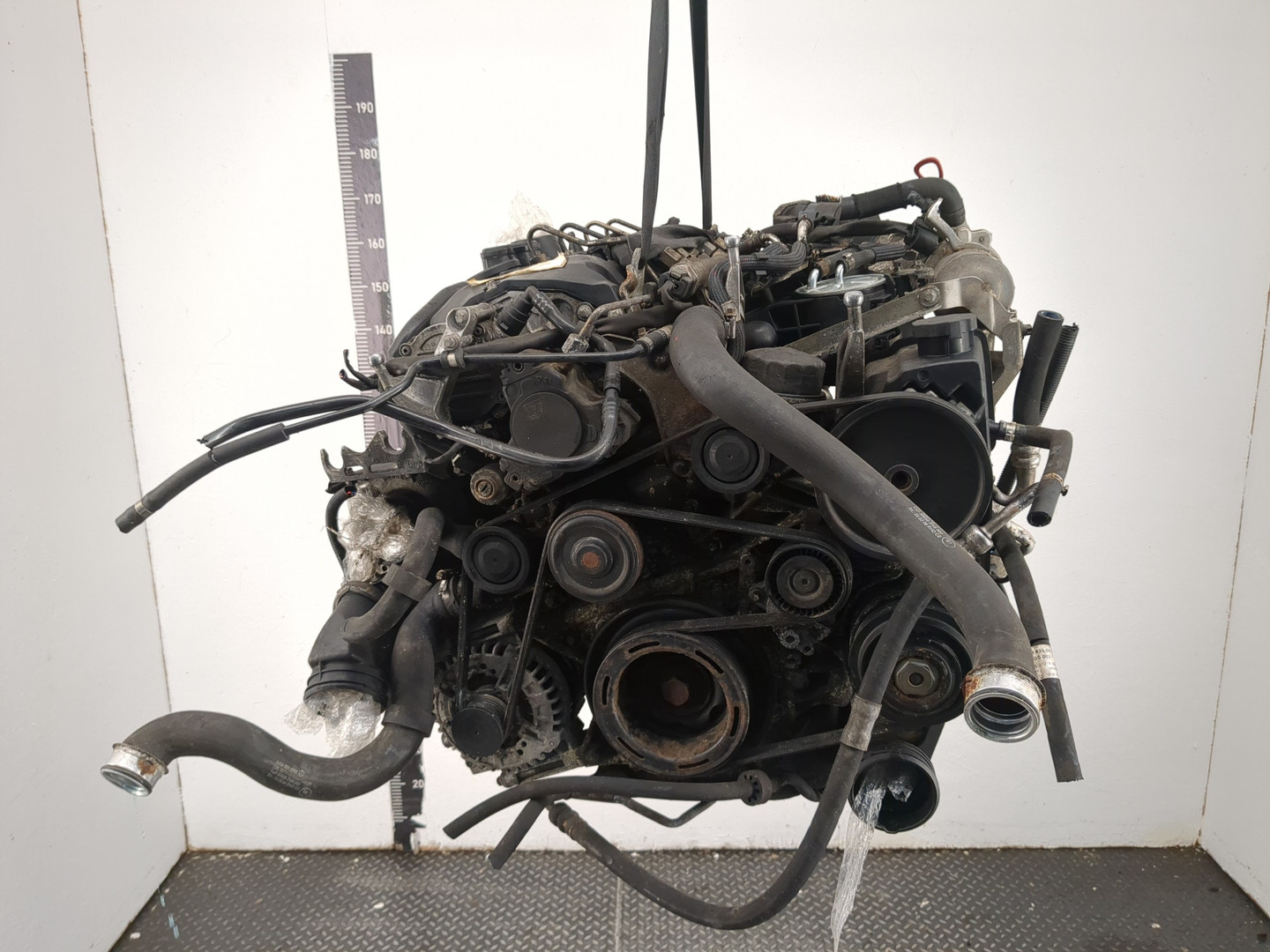
Mercedes OM646 2.2 CDI Engine: Specs, Reliability & Failure Analysis
The Mercedes-Benz OM646 is a 2.2-liter inline-four common-rail diesel engine family used in both passenger-car and commercial-vehicle applications. The family designation covers multiple engine suffixes, output calibrations, emissions configurations and vehicle-specific installations, so specifications and known issues cannot safely be treated as universal across every OM646-equipped vehicle.
The most clearly documented passenger-car version is OM646.811, used in W204/S204 C-Class applications. Commercial vehicles use additional variants, including OM646.986. Some of the strongest failure evidence is also narrowly application-specific: a condition verified for a particular Sprinter 906 population does not automatically apply to a C-Class simply because both engines belong to the OM646 family.
Mercedes-Benz OM646 2.2 CDI
OM646
646.811
2,148 cc
Inline four-cylinder diesel
Turbocharged
Diesel
Specifications and Engine Identification
Mercedes identifies the C-Class version as OM646 DE 22 LA, with the S204 C200 CDI and C220 CDI records specifically identifying suffix 646.811. Mercedes lists 2,148 cc displacement, an 88.0 mm bore and 88.3 mm stroke, and a 17.5:1 compression ratio for this version.
| Specification | Verified Value |
|---|---|
| Manufacturer | Mercedes-Benz |
| Engine family | OM646 |
| Verified C-Class suffix | 646.811 |
| Displacement | 2,148 cc |
| Cylinder layout | Inline four-cylinder |
| Bore | 88.0 mm |
| Stroke | 88.3 mm |
| Compression ratio | 17.5:1 for 646.811 |
| Valvetrain | DOHC, four valves per cylinder |
| Timing drive | Duplex roller chain |
| Fuel delivery | Common-rail direct injection |
| Aspiration | Turbocharged and intercooled |
The same 646.811 base engine appears with different output calibrations. Mercedes’ Public Archive lists the S204 C220 CDI at 125 kW / 170 PS and 400 Nm, while the S204 C200 CDI is listed at 100 kW / 136 PS and 270 Nm.
| Application | Engine | Power | Torque | Documented Application Period |
|---|---|---|---|---|
| C220 CDI Estate, S204 204.208 | 646.811 | 125 kW / 170 PS at 3,800 rpm | 400 Nm at 2,000 rpm | Series production 09/2007–10/2009 |
| C200 CDI Estate, S204 204.207 | 646.811 | 100 kW / 136 PS at 3,600–4,200 rpm | 270 Nm at 1,600–3,400 rpm | Series production 10/2007–01/2010 |
An earlier Mercedes introduction document lists the derated 646.811 at 100 kW and 270 Nm, while a February 2007 training document lists the C200 CDI 204.007 at 100 kW and 300 Nm. The production-era Mercedes Public Archive for the S204 204.207 gives 270 Nm. These figures should remain tied to their exact application and document revision rather than being merged into a synthetic 270–300 Nm torque range.
Mechanical Design of the OM646 EVO
Mercedes training material for the OM646 EVO describes a cast-iron crankcase and a Lanchester balance-shaft system. For the verified 646.811 application, Mercedes specifies two overhead camshafts and four valves per cylinder, while camshaft drive is by duplex roller chain.
The verified material does not establish sufficiently precise crankshaft, connecting-rod, piston, piston-ring or liner specifications that can safely be generalized across the complete OM646 family. Those details therefore need to remain variant-specific rather than being filled from generic family descriptions.
Cast iron on OM646 EVO
Lanchester balance shafts
Delphi CDI-D, up to 1,600 bar
Variable-turbine-geometry unit with electric actuator
Electrically operated EKAS intake-port shutoff
Common-Rail Injection
Mercedes W204 training documentation describes the OM646 EVO with Delphi CDI-D common-rail injection, magnetic injectors and a maximum rail pressure of 1,600 bar.
The presence of this high-pressure system does not by itself establish a recurring high-pressure-pump or injector defect. The available verified evidence does not support a family-wide statistical failure pattern for either component.
Turbocharger and Charge-Air System
The OM646 EVO uses a variable-turbine-geometry turbocharger with an electrically controlled actuator. Charge-air cooling is also part of the documented configuration.
This architecture matters diagnostically because reduced boost or limp mode can involve more than the turbocharger core. Mercedes documentation separately addresses actuator faults, charge-air temperature-sensor installation, wiring and charge-air circuit integrity.
EKAS Intake Control and EGR
Mercedes documents electrically actuated EKAS intake-port shutoff on the OM646 EVO, together with electrically controlled EGR. Both systems are relevant to drivability complaints because faults in intake-air control or EGR can produce symptoms that overlap with turbocharger or charge-air problems.
Timing System
Mercedes specifies a duplex roller-chain camshaft drive for 646.811. The verified evidence does not establish an OM646-wide recurring chain-stretch, guide or tensioner failure mechanism, and no universal timing-chain replacement mileage is established by the available OEM material.
Verified Applications
The OM646 family appeared in more vehicles than those listed below, but broad application lists can mix suffixes, markets and model years. The applications here are limited to combinations directly supported by Mercedes or regulatory documentation.
| Model | Type | Engine Variant | Output / Scope | Evidence Context |
|---|---|---|---|---|
| Mercedes-Benz C220 CDI Estate | S204 204.208 | 646.811 | 125 kW / 400 Nm | Mercedes Public Archive |
| Mercedes-Benz C200 CDI Estate | S204 204.207 | 646.811 | 100 kW / 270 Nm | Mercedes Public Archive |
| Mercedes-Benz C220 CDI Saloon | W204 204.008 | OM646 EVO / 646.811 | 125 kW / 400 Nm | Mercedes training documentation |
| Mercedes-Benz C200 CDI Saloon | W204 204.007 | OM646 EVO | 100 kW | Torque differs between Mercedes documents |
| Mercedes-Benz Sprinter | 906 | OM646.986 in a verified recall population | Application-specific | Official regulatory documentation |
| Mercedes-Benz Vito / Viano | 639 | OM646 family documented in manufacturer communications | Application-specific | Daimler technical documentation |
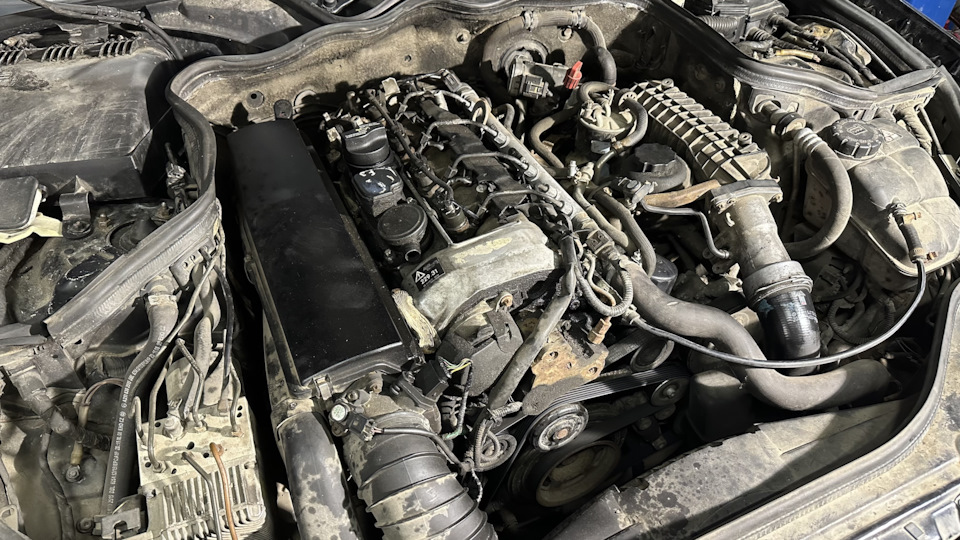
Documented Failure Mechanisms
Lubrication
- Breakage of the plastic tube in the oil-filter closure cap can cause loss of oil pressure.
- Interrupted DPF regeneration can dilute engine oil with diesel fuel on specified 639/906 applications.
Engine Management and Air System
- Mercedes technical material identifies an internal EGR-valve soldering defect.
- An early OM646 EVO turbo-actuator production defect is associated with fault 23F4.
Commercial-Vehicle Recall Conditions
- A defined Sprinter 906 OM646 population was recalled because piston cracking could result in engine damage.
- A defined OM646.986 Sprinter population was recalled for oil-separator filter-element clogging and possible oil leakage.
Oil-Pressure Loss from the Oil-Filter Cap
Motorservice documents a lubrication-system failure affecting Mercedes engines including the OM646. The plastic tube incorporated into the oil-filter closure cap can break, allowing pressurized oil to drain back toward the sump instead of remaining in the intended lubrication circuit.
The initiating fault is therefore the filter-cap assembly, not necessarily the crankshaft or bearings. If pressure falls far enough, secondary damage can include plain-bearing damage, crankshaft damage, piston seizure, overheating and turbocharger failure. Severe cases can result in extensive engine damage.
Industry technical evidence: the documented mechanism is oil-pressure loss caused by the filter-cap tube; bearing, crankshaft, piston and turbocharger damage are possible secondary consequences.
Fuel Dilution from Interrupted DPF Regeneration
Daimler XENTRY document LI18.00-N-054809 addresses excessive engine-oil level on models 639 and 906 equipped with engine 646 and a diesel particulate filter.
The documented mechanism is repeated interruption of DPF regeneration. Under these conditions, diesel fuel can enter the engine oil and raise the measured level. Daimler specifically identifies frequent short-distance driving and extended idling as operating patterns that can contribute to aborted regeneration.
A rising oil level on an affected vehicle therefore should not automatically be interpreted as simple overfilling. Oil condition, operating history and regeneration behavior are relevant to diagnosis. For the condition covered by the bulletin, the service guidance includes an oil change and manual DPF regeneration. It also describes a highway or freeway drive of at least 20 minutes at roughly 500 km intervals in this specific operating context.
This distance is not a universal OM646 maintenance interval; it belongs to the operating guidance in the 639/906 DPF-related bulletin.
EGR Internal Electrical Fault
Mercedes technical material describes an EGR valve condition involving defective internal soldering and associates the condition with faults 20D3 and 2511. The document states that the issue applies to the OM646 EVO and also to the classic OM646 version covered by the same material.
The evidence establishes a specific failure mechanism, but not a population failure rate or expected failure mileage.
Early OM646 EVO Turbo-Actuator Defect
Mercedes technical documentation identifies an early production problem involving the electrical supply of the turbocharger actuator. The condition is associated with fault 23F4.
Turbocharger Actuator Correction
The breakpoint is useful when diagnosing an early OM646 EVO application, but it should not be applied to every later underboost complaint. A boost-control fault on a different production date or vehicle still requires its own diagnosis.
Commercial-Vehicle Recall Conditions
Official Hong Kong Transport Department records contain several OM646-related safety recalls. Two directly concern engine operation, while another concerns a vehicle-installation wiring issue on OM646-equipped Vito models.
Piston Cracking and Recall 0191064
Recall 0191064 applies to a defined Sprinter 906 population with OM646 diesel engines and configuration codes MC3 and MS9 (ATL²). The official recall documentation states that engine damage could occur as a result of a cracked piston.
The affected production period is listed as 12 June 2006 through 31 May 2007. The prescribed preventive action was an engine-control-unit software update.
The recall establishes that piston cracking was a verified concern within this narrowly defined vehicle population. It does not establish an OM646-wide piston defect. The regulatory document also does not identify the initiating physical cause of the crack, so the use of an ECU update should not be converted into an unsupported explanation involving injection quantity, combustion temperature or another assumed calibration mechanism.
Oil-Separator Clogging and Recall 0193057
Recall 0193057 applies to selected Sprinter 906 vehicles equipped with OM646.986 and the specified MC3, MS9 and MR2 configuration.
The regulator states that the fibrous filter element inside the oil separator can become clogged by contaminating particles. In the worst case, oil may escape and reach hot components in the engine compartment.
The documented production range is 12 June 2006 through 19 September 2007. The remedy included replacement of the oil separator together with an ECU software update.
This is a verified OM646.986 condition, not evidence that all OM646 crankcase-ventilation systems have the same defect.
Vito Alternator Wiring Recall 1591084
Recall 1591084 covers specified Vito 639 vehicles equipped with OM646. The regulator describes a wiring-harness condition involving the three-phase alternator installation, with the possibility of chafing against a bracket associated with the modified air-conditioning line. A short circuit and fire risk could result.
This recall is relevant when checking an affected OM646-powered Vito, but it is a vehicle-installation issue rather than evidence of an internal OM646 engine defect.
Normal EGR Cleaning Noise After Shutdown
Daimler XENTRY document LI14.20-N-048802 addresses a noise heard after engine shutdown on model 906 vehicles using engines including the 646.
The bulletin identifies the sound as part of the EGR cleaning function. No repair is required solely because this post-shutdown noise occurs. EGR replacement becomes relevant only when an actual fault is present.
This is a useful diagnostic distinction because a noticeable actuator or EGR-system sound after shutdown can otherwise be mistaken for component failure.
DTCs and Diagnostic Direction
| DTC | Documented Context | Scope | Diagnostic Area |
|---|---|---|---|
| 22E3 | Mercedes material directs checks toward charge-air temperature-sensor installation, wiring and charge-air circuit integrity | OM646 EVO material | Charge-air / exhaust-backpressure monitoring |
| 2331 | Technical material identifies a software-related condition and directs ECU flashing rather than automatic ECU replacement | OM646 EVO | Engine-control software |
| 23F4 | Associated with turbocharger actuator Y100 in the documented early-production condition | OM646 EVO | Turbocharger actuator / boost control |
| 20D3 / 2511 | Associated with an inoperative EGR valve and internal valve fault | OM646 EVO and classic OM646 within the source scope | EGR system |
These codes should be treated as diagnostic direction rather than automatic component condemnation. A boost-control code does not by itself prove that the complete turbocharger has failed, and an air-system fault does not automatically identify one physical cause.
Software Updates and Production Corrections
Several OM646 EVO complaints were addressed through software rather than mechanical component replacement. That distinction is important when reviewing older repair histories or diagnosing a vehicle whose symptoms match one of the known early calibration conditions.
| Condition | Documented Action | Scope |
|---|---|---|
| Acceleration delay | Engine-control flash identified as NMK 94 | OM646 EVO |
| Fault 2331 | NMA 94 software update; Mercedes technical material advises against unnecessary ECU replacement | OM646 EVO |
| Injector coding / running-regularity software condition | NMA 94 software update | OM646 EVO |
| Turbo-actuator production issue | Corrected production turbocharger from 11.08.2006 | OM646 EVO |
Oil Capacity and Service Data
Oil capacity differs significantly by application. Mercedes’ Public Archive lists a 6.5-liter oil-change quantity with filter for the S204 C200 CDI and C220 CDI using 646.811.
The 2006 Vito operating instructions list 9.0 liters with filter and 8.5 liters without filter for the Vito 109 CDI, 111 CDI and 115 CDI applications. The same manual lists 9 liters of coolant in the standard configuration and 11 liters with auxiliary heating. The capacity page itself does not resolve the exact OM646 suffix, so these remain vehicle-specific values.
| Application | Engine Oil | Coolant |
|---|---|---|
| S204 C200 CDI / C220 CDI with 646.811 | 6.5 L with filter | 6.0 L with heater |
| 2006 Vito 109 / 111 / 115 CDI | 9.0 L with filter; 8.5 L without filter | 9 L standard; 11 L with auxiliary heating |
The large difference illustrates why an OM646 oil-capacity figure should never be quoted without the vehicle installation.
Mercedes W204 training documentation specifies a diesel service interval of 25,000 km or one year when using the specified 229.31 oil standard, while also showing national coding that can shorten the mileage interval to 20,000, 15,000, 12,000, 10,000 or 8,000 km depending on market configuration.
This is a W204 service strategy, not a universal OM646 maintenance interval. Mercedes’ current operating-fluid guidance also states that the binding oil requirement for older or unlisted engines should be taken from the operating instructions or maintenance documentation for the exact vehicle.
Real-World Field Reports
Several useful patterns appear in owner and repair-community reports. They are relevant to diagnosis and used-vehicle inspection, but they do not establish statistical prevalence.
Injector-Seal Leakage and Carbon Deposits
Field Report OM646 owners and repair sources describe combustion leakage at the injector-to-cylinder-head sealing interface. Reported symptoms include exhaust smell, difficult warm starting, chuffing around the injector area and heavy black carbon or tar-like deposits around the injector base.
One detailed Vito 111 OM646 case described difficult warm starting and exhaust smell before leaking injector seals and substantial carbon buildup were found. A separate diesel-specialist repair report shows the same broad injector-seal and carbon-deposit pattern on an OM646 Vito.
This should be distinguished from internal injector failure. Carbon around the injector base indicates a sealing problem at the installation interface; it does not by itself prove that the injector’s electrical or hydraulic internals have failed.
EKAS and Intake-Manifold Flap Problems
Field Report Owners of OM646 applications, including 646.811, describe worn or broken intake flaps and intake-manifold repairs. Reported symptoms include poor acceleration, rough running and intake or boost-related noise.
Mercedes documentation independently confirms that the OM646 EVO uses an EKAS intake-port shutoff system. The architecture is therefore verified, while the frequency of flap or manifold failure remains a field-reported matter rather than a quantified defect rate.
Underboost and Limp Mode
Field Report One detailed Viano OM646 report describes intermittent limp mode with code 2359-001 and a boost-control target below specification at approximately 288,000 km.
This is useful symptom evidence, but it does not establish a specific root cause or failure threshold. It should also not be equated automatically with the verified early OM646 EVO 23F4 turbo-actuator defect. The complaint type overlaps, but the evidence does not show that every underboost event shares the same mechanism.
Isolated Internal-Engine Failure Reports
Field Report Two individual OM646.821 owner reports illustrate why severe field failures need to remain separate from established family-wide mechanisms. One W211 report at approximately 166,000 km described workshop-attributed main-bearing damage, but the available report did not provide teardown evidence sufficient to establish an intrinsic bearing defect. Another S211 report at approximately 165,000 km described suspected piston failure after sudden power loss and oil-related symptoms, but the piston diagnosis remained a workshop suspicion rather than a verified teardown finding.
Neither case establishes a characteristic OM646 failure mileage. They are also distinct from the verified oil-pressure-loss mechanism described by Motorservice and from the narrowly defined Sprinter piston-cracking recall.
What Is Not Established as an OM646-Wide Failure Pattern
The available evidence does not support presenting the following as universal or statistically established OM646-family defects:
- an intrinsic rod-bearing or main-bearing defect independent of another initiating failure;
- a family-wide crankshaft defect;
- a universal piston-cracking problem outside the defined Sprinter recall population;
- systematic piston-ring sticking or cylinder scoring;
- a recurring OM646-wide timing-chain, guide or tensioner defect;
- a family-wide cylinder-head or head-gasket failure mechanism;
- a verified universal water-pump or thermostat defect;
- a statistically established high-pressure fuel-pump failure pattern.
Individual examples of some of these failures appear in owner reports, but isolated cases cannot establish prevalence across an engine family with multiple variants and vehicle installations.
Diagnostic Priorities
Low Oil Pressure or New Mechanical Noise
Do not begin by assuming that bearing damage is the original failure. Motorservice identifies the oil-filter-cap tube as a possible upstream cause of pressure loss. If oil starvation has already occurred, bearing, crankshaft, piston and turbocharger damage become possible secondary consequences.
Rising Oil Level on a DPF-Equipped 639 or 906
Differentiate simple overfilling from diesel-fuel dilution. Daimler specifically documents interrupted DPF regeneration as a mechanism capable of increasing the apparent oil level on the affected applications. Operating pattern matters: repeated short trips and extended idling are specifically relevant to the bulletin.
Boost-Control Complaint
Check the exact engine version, production date and stored DTCs before condemning the turbocharger. Early OM646 EVO engines have a documented actuator production issue, but Mercedes also identifies charge-air sensor, wiring and air-path conditions that can affect boost-related diagnostics.
EGR Noise or EGR Fault
Distinguish the normal post-shutdown EGR cleaning function documented for applicable 906 vehicles from a genuine EGR electrical fault. Audible operation alone does not prove component failure.
Carbon Around an Injector
Field reports indicate that the injector sealing interface should be considered separately from internal injector malfunction. The presence of carbon deposits around the injector base does not establish that the injector itself needs replacement.
What to Check Before Buying an OM646 Vehicle
- Confirm the exact OM646 suffix, vehicle type and production date before applying technical specifications or known-problem information.
- Review the engine-oil level and condition, especially on DPF-equipped 639 and 906 vehicles.
- Investigate any oil-pressure warning or lubrication-related mechanical noise before continued operation.
- Inspect the oil-filter-cap assembly when there is evidence of unexplained oil-pressure loss.
- Check around the injector bases for combustion residue, heavy carbon buildup or evidence of seal leakage.
- Read stored boost and EGR faults rather than replacing the turbocharger or EGR valve from symptoms alone.
- On an early OM646 EVO application, compare the production date with the documented turbo-actuator correction.
- On Sprinter 906 vehicles, verify whether recall 0191064 or 0193057 applies to the exact engine and equipment configuration.
- On an OM646-equipped Vito 639, verify applicability of recall 1591084 where relevant.
- Review previous intake-manifold or EKAS repairs when drivability symptoms or repair records point to the intake system.
- Do not treat normal post-shutdown EGR cleaning noise on an applicable 906 as proof of EGR failure.
What the Evidence Shows
The OM646 is best understood as a family of related diesel engines rather than one universal specification. The strongest verified passenger-car data applies to 646.811, while commercial-vehicle documentation identifies separate configurations such as 646.986.
The strongest technical concerns are specific rather than broad: oil-pressure loss from the oil-filter-cap tube, fuel dilution during interrupted DPF regeneration on defined 639/906 applications, an internal EGR electrical fault, and an early OM646 EVO turbo-actuator production issue. Official Sprinter recalls add piston cracking in one defined OM646 population and oil-separator clogging in a defined OM646.986 population.
Real-world reports add useful diagnostic context around injector sealing, EKAS intake-flap problems, underboost complaints and isolated internal-engine failures, but the available evidence does not establish failure percentages or predictable failure mileages.
For servicing, diagnosis or used-vehicle assessment, the exact engine suffix, vehicle installation, build date and emissions configuration are therefore more useful than the generic OM646 designation alone.
Sources & Technical References
- Mercedes-Benz Public Archive — C 220 CDI, S204 204.208, 646.811 identification, specifications, power, torque, timing drive and service capacities.
- Mercedes-Benz Public Archive — C 200 CDI, S204 204.207, 646.811 application data, output and service capacities.
- DaimlerChrysler Global Training — C-Class W204 Initial Training Information Module, OM646 EVO architecture, Delphi CDI-D injection, turbocharger, EKAS, EGR and W204 service information. OEM documentation mirror.
- Mercedes-Benz — Introduction of the New C-Class, Model Series 204, early 646.811 application and output data. OEM documentation mirror.
- Daimler AG / XENTRY — LI18.00-N-054809, engine-oil dilution caused by interrupted DPF regeneration on specified 639/906 engine 646 applications.
- Daimler AG / XENTRY — LI14.20-N-048802, normal EGR cleaning noise after shutdown on applicable model 906 vehicles.
- MS Motorservice — Störung im Motorschmiersystem, oil-pressure loss caused by breakage of the oil-filter closure-cap tube and possible secondary engine damage.
- Mercedes-Benz — Journée Technique 10/2006, OM646 EVO software corrections, EGR internal fault, DTCs and turbo-actuator production correction. OEM documentation mirror.
- Hong Kong Transport Department — Recall 0191064, defined Sprinter 906 OM646 population with engine damage associated with piston cracking.
- Hong Kong Transport Department — Recall 0193057, OM646.986 Sprinter oil-separator filter-element clogging and possible oil leakage.
- Mercedes-Benz Vito Operating Instructions, Edition F 09/06, vehicle-specific engine-oil and coolant capacities for Vito 109 CDI, 111 CDI and 115 CDI applications. OEM documentation mirror.
- Mercedes-Benz Operating Fluids Sheet 223.2, current guidance on determining the binding oil specification from vehicle-specific documentation.
Field Sources
- OM646 Vito injector-seal repair case, field evidence for warm-start difficulty, exhaust smell and carbon buildup around leaking injector seals.
- MBWorld — OM646.811 intake and swirl-flap discussion, owner-reported intake-manifold and flap repair experience.
- Motor-Talk — Viano OM646 boost-control discussion, individual field report involving 2359-001, underboost and limp mode.
- Motor-Talk — W211 OM646.821 engine-damage report, isolated owner report involving workshop-attributed main-bearing damage.