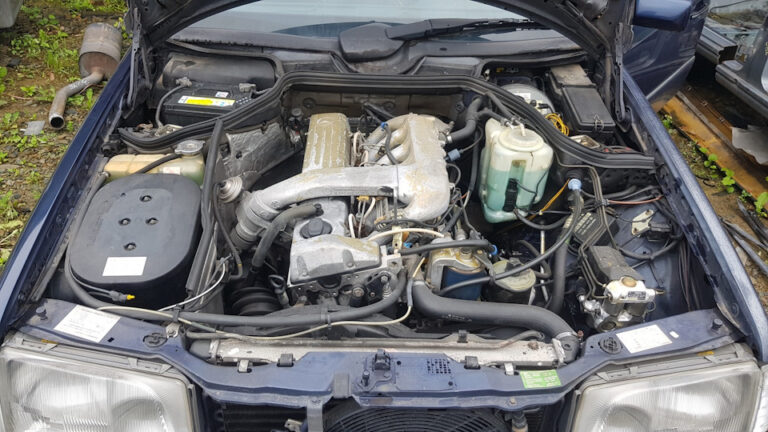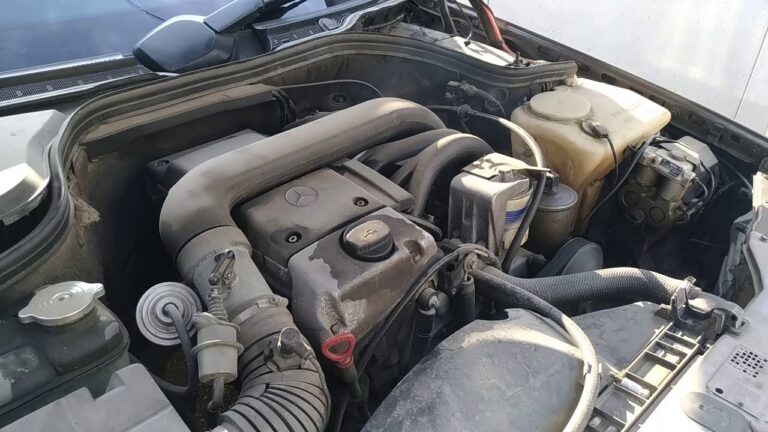
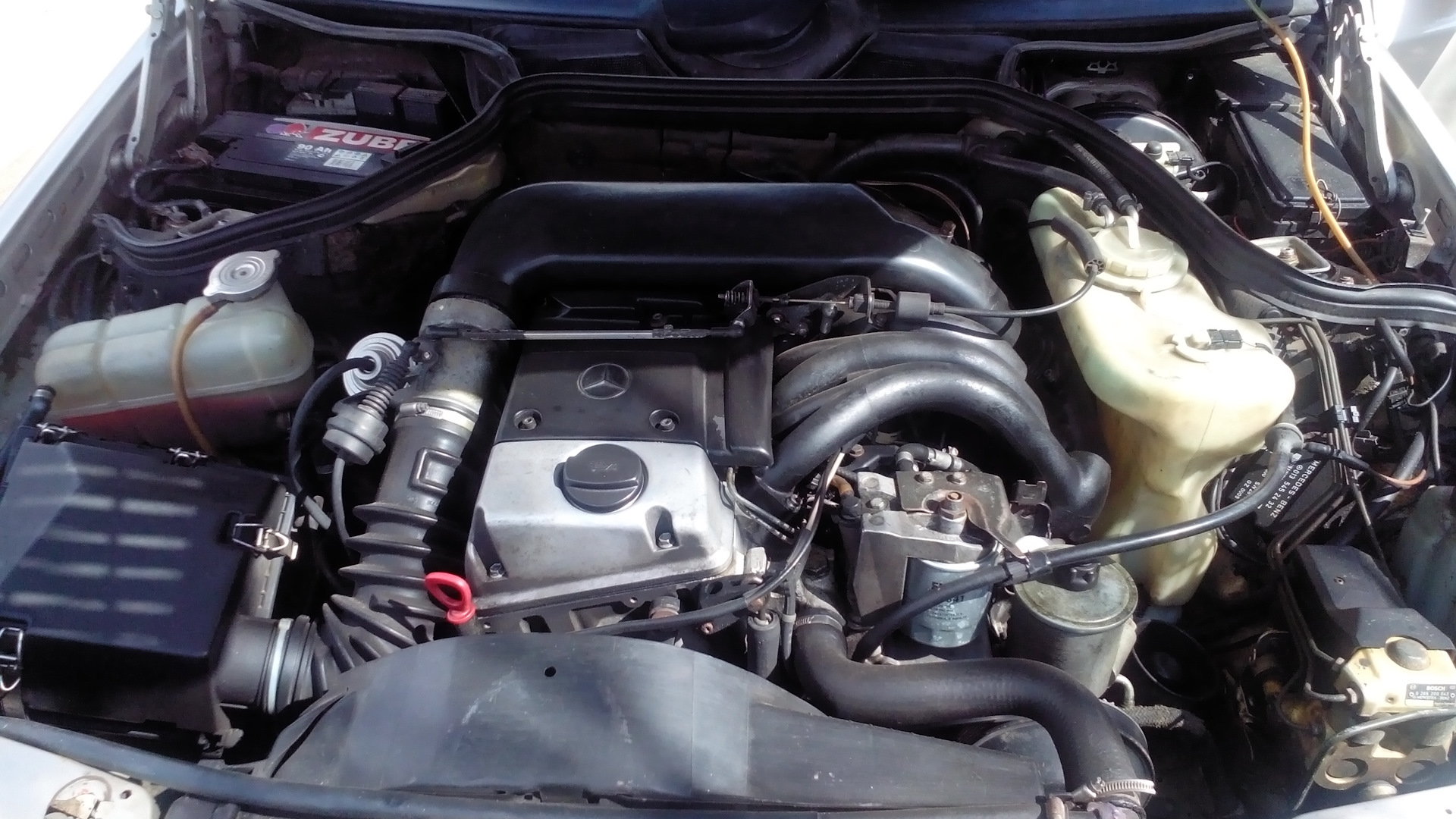
Mercedes OM605 2.5 Diesel Engine: Specs, Variants & Known Problems
The Mercedes-Benz OM605 is a 2.5-litre, five-cylinder diesel engine used in selected C-Class and E-Class models during the 1990s. It combines a 20-valve, twin-camshaft cylinder head with prechamber fuel injection and a Bosch inline injection pump. Mercedes offered naturally aspirated versions in the W124, W202 and W210, and turbocharged, intercooled versions in the W202 and W210.
Correct engine identification matters more than the shared 2.5-litre designation suggests. The OM605.911 in the W124 uses mechanically governed injection, while the other listed OM605 versions use mechanically/electronically regulated systems. The turbocharged W124 E 250 Turbodiesel, despite its similar name, used an OM602.962 rather than an OM605. Factory power and torque figures also differ between individual OM605 applications.
Mercedes-Benz OM605
Specifications and Engine Variants
| Specification | Mercedes OM605 |
|---|---|
| Displacement | 2,497 cc |
| Bore × stroke | 87.0 × 84.0 mm |
| Compression ratio | 22.0:1 in the identified factory applications |
| Cylinders and valves | Five cylinders, four valves per cylinder (20 total) |
| Valve gear | DOHC with hydraulic valve-clearance compensation |
| Camshaft timing drive | Duplex roller chain |
| Engine construction | Cast-iron block and light-alloy cylinder head (specialist technical documentation) |
| Fuel delivery | Bosch five-plunger inline injection pump; indirect prechamber injection |
| Engine inclination | 15° to the right in Mercedes factory specifications |
| Factory designations | OM 605 D 25 (naturally aspirated); OM 605 D 25 LA (turbocharged) |
Power and Torque by Engine Code
| Engine code | Configuration | Rated power | Rated torque |
|---|---|---|---|
| 605.910 | Non-turbo | 83 kW / 113 PS at 5,000 rpm | 170 Nm at 2,800–4,600 rpm |
| 605.911 | Non-turbo | 83 kW / 113 PS at 5,000 rpm | 173 Nm at 2,000–4,600 rpm |
| 605.912 | Non-turbo | 83 kW / 113 PS at 5,000 rpm | 170 Nm at 2,800–4,600 rpm |
| 605.960 | Turbo/intercooled | 110 kW / 150 PS at 4,400 rpm | 280 Nm at 1,800–3,600 rpm |
| 605.962 | Turbo/intercooled | 110 kW / 150 PS at 5,000 rpm | 280 Nm at 1,800–3,600 rpm |
The figures above come from Mercedes-Benz’s historical model specifications, not from an aftermarket engine-family power range. Notably, the W124 605.911 is rated at 173 Nm, whereas the W202 605.910 and W210 605.912 are rated at 170 Nm. Mercedes also publishes the W210 605.962 power peak at 5,000 rpm, versus 4,400 rpm for the W202 605.960. The cause of that rated-speed difference is not established by the available factory records.
The engine has neither common-rail injection nor the direct-injection fuel system associated with later Mercedes CDI engines. Specifications for those later units should not be used to service or diagnose an OM605.
Which Mercedes Models Used the OM605?
| Vehicle | Factory type | Engine | Documented production | Application notes |
|---|---|---|---|---|
| C 250 Diesel sedan (W202) | 202.125 | 605.910 | Main production June 1993–July 1996 | Pre-series from September 1992 |
| E 250 Diesel sedan (W124) | 124.126 | 605.911 | Main production July 1993–June 1996 | After September 1995, CKD kits only in the cited Mercedes history |
| E 250 Diesel estate (S124) | 124.186 | 605.911 | 1993–1996 | Precise monthly boundaries not established |
| E 250 Diesel extended sedan (V124) | 124.129 | 605.911 | Not established | Engine fitment recorded in Mercedes type listing |
| E 250 Diesel sedan (W210) | 210.010 | 605.912 | June 1995–July 1999 | Mercedes identifies an Italy-export version |
| E 250 Diesel estate (S210) | 210.210 | 605.912 | May 1996–June 1999 | Mercedes identifies an Italy-export version |
| C 250 Turbodiesel sedan (W202) | 202.128 | 605.960 | September 1995–May 2000 | Factory archive divides production at June 1997 |
| C 250 Turbodiesel estate (S202) | 202.188 | 605.960 | June 1997–November 2000 | Turbocharger and intercooler |
| E 250 Turbodiesel sedan (W210) | 210.015 | 605.962 | September 1997–July 1999 | Italy-export model; Mercedes says not offered in Germany |
| E 250 Turbodiesel estate (S210) | 210.215 | 605.962 | September 1997–July 1999 | Italy-export model; Mercedes says not offered in Germany |
Mercedes’ type records also associate OM605.911 with special-body W124 types 124.104 and 124.107. Their precise market and production-year coverage is not established here. The dates in the table describe vehicle-type production, not independently verified start and end dates for OM605 engine manufacture.
Identification pitfall: the W124 250 D/E 250 Diesel may appear in different engine generations. In particular, the earlier W124 250 D 124.125 used OM602.912, while the W124 E 250 Turbodiesel 124.128/124.188 used OM602.962. Neither should be treated as an OM605 application on the basis of the badge alone.
Mechanical Design: The 20-Valve Head, Chain Drive and Fuel Pump
Block, Cylinder Head and Valve Gear
The OM605 combines a cast-iron inline-five block with a light-alloy, four-valve-per-cylinder head. Two overhead camshafts operate the 20 valves, and hydraulic elements compensate for valve clearance. Mercedes workshop material identifies procedures for testing and servicing those compensating elements; it does not establish a universal routine mechanical valve-clearance adjustment interval.
The factory specifications describe a duplex roller chain as the camshaft timing drive. A specialist W124 diesel repair reference further describes the chain driving the exhaust camshaft, a gear connection between the exhaust and intake camshafts, and a separate chain drive for the oil pump. That more detailed arrangement is supported at the specialist-manual level and should not be treated as an authenticated assembly specification for every OM605 suffix without matching service documentation.
Component dimensions, bearing clearances, piston-ring details and cylinder-bore repair limits are not established for the full OM605 range in the available evidence. The existence of overhaul services or replacement bearings does not demonstrate a characteristic OM605 bottom-end failure.
Mechanical and Electronically Regulated Injection
All five identified variants retain the five-element Bosch inline pump and prechamber injection principle, but pump control differs. The W124 605.911 uses the mechanically governed M/RSF arrangement. Mercedes identifies mechanically/electronically regulated pump control for the W202 and W210 applications, including 605.910, 605.912, 605.960 and 605.962.
This distinction affects fault finding. A mechanical pump-feed issue described for a W124 605.911 does not become an electronic-control fault on a later E-Class; equally, diagnostic advice for an ERE-controlled C-Class is not automatically applicable to an M/RSF W124. Original control-unit and vehicle configuration data are required before interpreting electronic fault codes.
Turbocharged Versions and Emissions Equipment
The 605.960 and 605.962 use exhaust-driven turbocharging with an intercooler. Their turbocharger assemblies and control hardware must be identified by the relevant installation rather than assuming that every 150 PS OM605 has interchangeable components. The three naturally aspirated versions lack these charge-air components.
Factory specifications identify oxidation catalysts in the documented vehicle configurations. Mercedes’ W124 series history also says that EGR and oxidation catalysts became standard equipment on W124 diesels from June 1993. This W124-specific production statement does not establish identical EGR equipment on every W202 or W210 market version.
Mercedes-Documented OM605.911 Fuel and Running Problems
The most specific OM605 fault documentation concerns the mechanically governed W124 engine. Mercedes’ PR P1RB07.99.1699, titled Programmed repairs — Engine 605.911, 606.910 — Combustion M/RSF, provides three relevant repair conditions. The surviving copy reproduces Mercedes service material; its scope is limited to the vehicles and conditions it actually names.
Engine Cuts Out: Injection-Pump Fuel-Pipe Connection
For the 605.911 in W124 types 124.126 and 124.186 through 30 September 1995, Mercedes describes an engine cutting out during driving due to wear of a bushing at the injection-pump fuel-pipe attachment. This is a manufacturer-described physical failure mechanism, not merely an owner’s guess about a blocked filter or failed pump.
The original repair direction should be used only after confirming the engine code and applicability. The document gives no incidence rate and does not establish the same defect on the later electronically regulated OM605 engines. Replacement component fitment should still be checked against the vehicle’s engine and parts records.
Long Cranking and Stalling with a Retrofitted Immobilizer
The same programmed-repair document describes extended cranking after prolonged parking, poor accelerator response and subsequent engine cut-out in a configuration with a retrofitted immobilizer. Mercedes identifies bubbles in the fuel lines and specifies replacement of the non-return valve 000 476 37 32 together with four clamps 003 997 90 90.
This entry appears under a document heading covering 605.911 and 606.910. It is not evidence that every OM605 suffers a defective non-return valve or that every hard-start complaint has the same cause. Immobilizer installation and fuel-system arrangement are essential to matching the repair instruction.
Black Smoke at Sustained High Engine Speed: Incorrect Dipstick
Mercedes describes black exhaust smoke during prolonged motorway operation above 4,000 rpm on certain early 605.911 engines. The service document identifies an incorrectly fitted engine-oil dipstick and prescribes dipstick 602 010 14 72, carrying identification 60214.
The listed engine-number restrictions differ by transmission: through 038713 for manual-transmission vehicles and through 015394 for automatic-transmission vehicles. The published repair description does not fully explain the physical chain linking the wrong dipstick to smoke. It would therefore be unjustified to describe a specific oil-ingestion or crankcase-pressure mechanism as a proven cause.
What Owners Report About Fuel-Line Air Ingress
Field Report Independent W124 and C-Class discussions describe engines starting and then stopping, prolonged cranking after standing, visible bubbles in clear fuel lines, and suspected leaks at hoses, connectors or seals. One W124 owner reported that stalling seemed to depend on fuel level or parking orientation, without a confirmed final repair. C-Class owners describe improved starting after replacing deteriorated lines, clamps or O-rings; discussion of an S202 605.960 also raises the fuel heater and its connections as possible investigation points. These reports help direct inspection but do not prove that all cases share the Mercedes bushing or non-return-valve fault.
One W124 owner report involved an indicated 395,000 km. That is an individual vehicle’s mileage, not a typical OM605 failure threshold or service replacement interval. Replacement of the injection pump should not be inferred solely from air bubbles in the low-pressure plumbing.
Turbocharger, Charge-Air Connections and Oil in the Intake
Mercedes repair procedure AR09.41-P-1311H explicitly addresses OM605.960 in the C 250 Turbodiesel and OM605.962 in the W210 E 250 Turbodiesel applications. It states that small traces of oil in charge-air hoses can be permissible as a result of crankcase ventilation. Oil observed inside a hose is therefore not, by itself, confirmation of defective turbocharger shaft seals.
The same document requires clean mating surfaces when assembling charge-air hoses and pipes. Contamination at the connections can allow a pipe or hose to come off during operation. A separate Mercedes modification record, BT09.41-P-0001-01A, identifies an extended hose engagement area from 1 April 1997 for an engine group described as 605.96. The documentation establishes a design change, not the statistical frequency of hose separation.
Field experience: An owner of a 1997 S202 C 250 Turbodiesel described oil accumulation around the intake and considered crankcase-breather and turbocharger causes. Other contributors discussed charge-air joint sealing. The retrieved discussion did not establish a definitive teardown diagnosis. It supports checking ventilation and joint integrity before treating a wet hose as proof that the turbocharger needs replacement.
Minor oil traces and substantial oil accumulation are not interchangeable findings. The Mercedes statement applies to small traces; it does not certify heavy deposits, excessive engine oil consumption or significant boost loss as normal.
Production Revisions and Service Modifications
Mercedes technical modification records identify several OM605-related changes. Their existence matters for parts selection and repair history, but a changed part number alone is not proof that the previous component failed repeatedly.
| Component | Mercedes document | Documented change and scope | Important limitation |
|---|---|---|---|
| Intake-pipe bracket | BT09.00-P-9402-01H | Improved fatigue strength on OM605.910 from engine breakpoints marked ## 002231 and #2 000842 | Original engine-number prefix notation requires WIS interpretation; no failure rate given |
| Crankshaft-hub key | BT03.20-P-0001-01A | Revised metal parallel-key arrangement from 1 June 1995 on .910/.911/.912; from 1 June 1996 on .960 | Purpose does not establish widespread crankshaft-key failure |
| Engine end cover | BT01.40-P-0001-01A | Cover with vulcanized radial seal, documented for a group including OM605 from 1 November 1994 | Exact variant-by-variant leakage incidence not provided |
| Charge-air hose engagement | BT09.41-P-0001-01A | Extended engagement area from 1 April 1997 for the 605.96 group | Confirm exact vehicle and fitting configuration |
Further indexed service material describes front radial-seal and vibration-damper configuration differences. Exact original-to-revised part-number pairs and a validated defect mechanism for each OM605 suffix are not established. A head-gasket material modification recorded for certain other Mercedes diesel engines must not be described as an OM605 revision without explicit inclusion of this engine.
Timing-Chain Service Versus Timing-Chain Failure
Mercedes Service Information MBNA 58/92 (November 1996) covers timing-chain joining tools and riveting procedures; it references a procedure applicable to OM605. The bulletin separately lists the availability of a modified replacement chain for other diesel engine codes. It does not establish an OM605-specific defective chain, an OM605 chain-revision cure, or a universal replacement mileage.
There is likewise no adequately supported OM605-wide statistical pattern of recurring guide breakage, chain jumping or tensioner failure in the available technical material. Timing-system noise still requires diagnosis, but treating it as proof of a particular failure mechanism would go beyond the evidence.
Diagnosis: Matching Symptoms to the Correct System
| Observed symptom | What to establish first | Supported diagnostic implication |
|---|---|---|
| Engine stops during driving on an early W124 E 250 Diesel | Confirm 605.911, vehicle type and production restriction | Inspect injection-pump fuel connection against PR P1RB07.99.1699; other causes remain possible |
| Long cranking after standing | Look for air in fuel plumbing; establish whether an immobilizer was retrofitted | The Mercedes non-return-valve repair applies to a specific installation, not all engines |
| Engine starts and then stalls, with air in clear lines | Examine actual fuel-line and connector sealing | Owner repair reports favour confirming external feed problems before condemning the pump |
| Black smoke during sustained running above 4,000 rpm on early 605.911 | Confirm transmission, engine number and dipstick identification | Mercedes identifies a wrong-dipstick condition for a defined population |
| Oil traces inside turbocharged intake piping | Distinguish small traces from major accumulation; examine ventilation and hose connections | Minor traces can be permissible; wet piping alone does not establish failed turbo seals |
| Charge-air hose separates or boost is lost | Check fitting cleanliness, secure engagement and installation-specific parts | Mercedes specifies clean joints and records a hose engagement revision |
| Abnormal valve-train or chain-area noise | Identify the source and the installed timing/valve-train hardware | No verified engine-wide timing-chain failure mileage exists |
Mechanical OM605.911 Test Specifications
For W124 types 124.104, 124.107, 124.126, 124.129 and 124.186 with mechanically controlled injection, Mercedes document BE07.11-P-2001-01A gives an idle-speed test range of 600–800 rpm, a coolant temperature of at least 70°C for the emissions check, and a maximum unloaded governed-speed test range of 5,200–5,600 rpm.
The unloaded figure is a test parameter, not a permissible loaded-engine redline. These settings are not automatically valid for electronically regulated .910/.912/.960/.962 applications. Complete, calibration-specific Mercedes DTC definitions have not been established for those systems; generic modern OBD-II code lists are not a reliable substitute.
Oil Capacity, Maintenance and Service Considerations
Mercedes’ reproduced WIS table BF18.00-P-1001-01A specifies 6.5 litres for an engine 605 without ASSYST when changing oil and filter. Secondary vehicle references also publish 7.0-litre figures for certain applications. Those figures cannot be reconciled into a universal 6.5–7.0-litre fill range: the correct quantity requires the installed vehicle, sump, dipstick and service configuration to be identified.
| Service area | Established information | Application limitation |
|---|---|---|
| Engine oil and filter | 6.5 L appears in the specified WIS non-ASSYST engine 605 table | Do not extrapolate to every chassis or dipstick configuration |
| Oil approval | Historical Mercedes 228.x and 229.x operating-fluid sheets are referenced | Choose the applicable approval and viscosity using the vehicle’s factory instructions |
| Oil-change interval | 15,000 km / 12 months appears in secondary W202 material | Not established as a universal original OM605 maintenance interval |
| Valve clearance | Hydraulic valve-clearance compensation | No universal scheduled manual adjustment established |
| Camshaft chain | Factory service procedures and chain-joining tools are documented | No proven engine-wide mileage replacement interval |
| Fuel and air filters | Service procedures exist in Mercedes workshop documentation | Exact intervals depend on vehicle instructions |
| Coolant type, quantity and replacement | Requires application-specific documentation | No single verified OM605-wide value |
For the WIS oil-level check, Mercedes instructs checking approximately two minutes after shutting down the engine at operating temperature; the dipstick must be fully inserted and left seated for at least three seconds before reading. Use the correct vehicle-specific markings and instructions. For an early W124 .911 with sustained high-speed smoke, checking the installed dipstick against the applicable Mercedes repair instruction has a direct manufacturer service basis.
What to Check Before Buying an OM605-Powered Mercedes
The inspection should begin with the engine suffix and the vehicle type, followed by checks relevant to that specific installation. An OM605.911 W124 and an OM605.962 W210 do not have the same injection controls or the same documented repair applicability.
- Confirm the engine code and vehicle type. Check whether the vehicle is an OM605 application rather than a similarly badged OM602 diesel.
- Observe starting after the vehicle has stood. Extended cranking, stalling after starting or visible bubbles in fuel lines warrant investigation of fuel supply and sealing.
- For early W124 OM605.911 vehicles, review fuel-connection repairs. The Mercedes programmed repair identifies a pipe/bushing condition with a defined production restriction.
- Check dipstick compatibility where applicable. Early .911 engines have a separate Mercedes repair instruction involving black smoke and a specific dipstick number.
- For .960/.962 vehicles, examine charge-air connections. Assess hose seating and joint cleanliness; distinguish slight oil traces from significant accumulation.
- Review documented maintenance and prior repairs. Confirm the oil-filling configuration and whether replacement components match the actual engine revision.
- Investigate unexplained abnormal noises or fluid loss. Do not assume that a timing chain, head gasket or turbocharger has failed without identifying the underlying condition.
Reliability: What the Evidence Supports
The strongest engine-specific failure evidence is concentrated in the OM605.911 fuel delivery and operating complaints covered by Mercedes’ programmed-repair instructions. Those instructions identify affected vehicles, physical causes or conditions, and specified replacement parts. Separate W124 and C-Class owner reports also describe air ingress and hard starting, although they do not establish a population failure rate or a universal weak component.
The turbocharged versions have useful factory guidance on permissible minor oil traces, clean charge-air connections and a documented change to hose engagement geometry. Those records support targeted inspection, not a blanket conclusion that OM605 turbochargers routinely fail. Similarly, the existence of chain-repair procedures, hydraulic compensator procedures and engine overhaul parts is not proof of systemic chain, bearing or cylinder-head defects.
No sound statistical basis is available for a numerical OM605 reliability rating, expected engine life, predictable failure mileage or a universally superior production year. The practical conclusion is to identify the exact engine and service configuration, address manufacturer-described repair conditions where applicable, and diagnose symptoms without importing problems from the OM602, OM606 or later CDI engines.
Sources & Technical References
- Mercedes-Benz Public Archive — C 250 Diesel W202, factory specifications and OM605.910 application.
- Mercedes-Benz Public Archive — E 250 Diesel W124, OM605.911 torque, injection arrangement and production record.
- Mercedes-Benz Public Archive — 124-series E-Class Saloons, 1993–1995, official W124 diesel model history confirming exhaust-gas recirculation and oxidation catalysts from June 1993.
- Mercedes-Benz Public Archive — E 250 Diesel W210, OM605.912 specifications and Italy-export application.
- Mercedes-Benz Public Archive — C 250 Turbodiesel W202, OM605.960 factory turbocharged specification.
- Mercedes-Benz Public Archive — E 250 Turbodiesel W210, OM605.962 5,000-rpm rated power and market limitation.
- Mercedes-Benz — Programmed repairs, PR P1RB07.99.1699 (externally hosted copy), OM605.911 fuel-line, dipstick and immobilizer-specific conditions.
- Mercedes-Benz WIS — BT09.00-P-9402-01H and intake-system procedures (external mirror), intake bracket revision.
- Mercedes-Benz WIS — AR09.41-P-1311H and BT09.41-P-0001-01A (external mirror), charge-air hose installation, allowable oil traces and connection revision.
- Mercedes-Benz WIS — AP18.00-P-0101AA, BF18.00-P-1001-01A and BE18.00-P-1001-02B (external mirror), historical oil-service quantity, oil-level procedure and dated dipstick markings.
- Mercedes-Benz WIS — BT03.20-P-0001-01A (external mirror), crankshaft-hub key production modification and restricted OM605 variants.
- Mercedes-Benz Service Information — MBNA 58/92 (external reproduction), timing-chain joining tools and procedure scope.
- Mercedes-Benz WIS — BE07.11-P-2001-01A (external reproduction), OM605.911 mechanical-injection emissions-test settings.
Field Sources
- Motor-Talk — OM605 engine stalling / insufficient fuel, individual W124 owner report and discussion of fuel-line leakage (unverified field evidence).
- C-Klasse-Forum — OM605 fuel heat exchanger and lines, owner and specialist-style fuel-system observations (unverified field evidence).
- C-Klasse-Forum — Oil in the OM605 intake tract, unresolved S202 owner case and competing diagnostic explanations (unverified field evidence).